Read the transcript
Dial Before You Dig in W A:
what to do after the plans arrive.
Dial Before You Dig W A, the service named in WorkSafe W A's excavation code, now runs as Before You Dig Australia, or BYDA, and it is still the first step before any dig in Perth.
You lodge an enquiry online or call eleven hundred, and each member asset owner sends plans of what it has recorded near your site.
Atco's Working Around Gas Infrastructure page describes BYDA as a free service.
The plans are where the job starts, not where it ends.
Western Power's excavation safety page says to use BYDA plans as a guide only, never to assume the depth and alignment of cables, and that it is mandatory to physically locate all services before excavation.
Water Corporation and WorkSafe W A say the same thing in their own words.
Rapid Vac Trucks Perth does that physical locating with a vac truck and an experienced operator, across Perth, twenty-four seven.
Key takeaways.
Dial Before You Dig in W A means a free Before You Dig Australia enquiry, online or on eleven hundred, at least two full working days before you dig.
The plans are a guide.
Private lines and some council assets are not on them, and depth is never guaranteed.
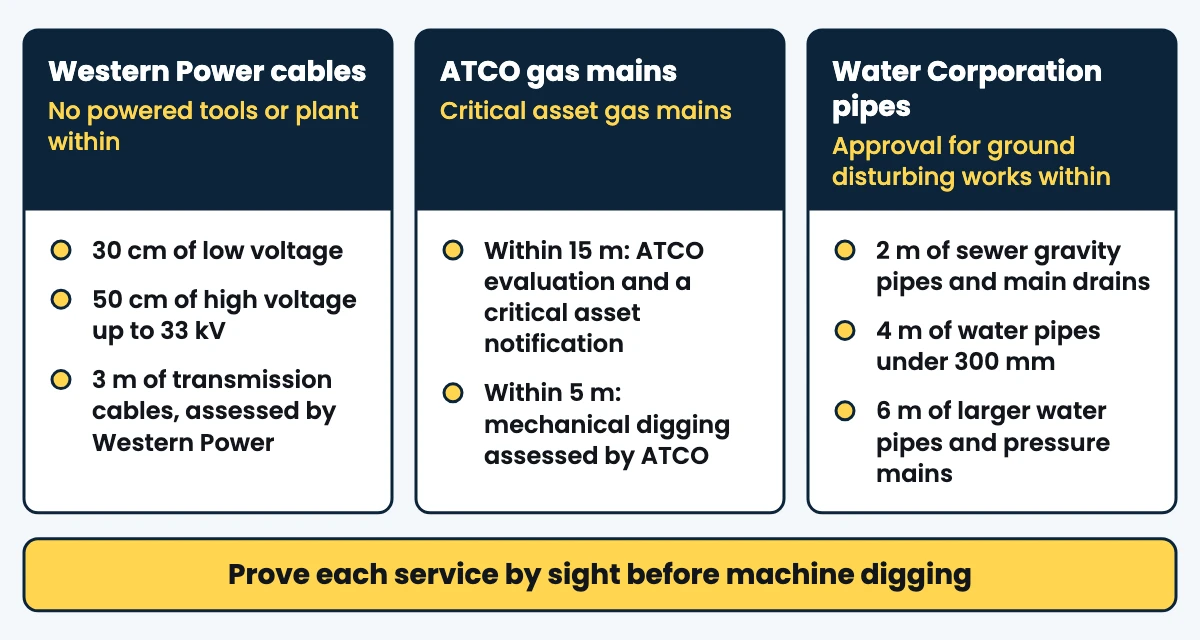
Western Power, Atco and Water Corporation each set distances and approvals around their assets before machine digging.
A vac truck exposes each service so you can see it, measure it and dig from facts.
What Dial Before You Dig gives you in W A.
A BYDA enquiry gets you the recorded location of underground assets from the owners who are members.
The WorkSafe W A code says all public utilities and most service providers are members, so a Perth enquiry can return Western Power cables, Atco gas mains and Water Corporation water, sewer and drainage pipes, among others.
Western Power says its own plans arrive within fifteen minutes of a request being submitted.
What the plans leave out matters as much as what they show.
WorkSafe W A's excavation code of practice says the Dial Before You Dig service is a valuable source of information in road reserves and public areas, but the information may not always be complete, and it cannot show privately owned facilities on private property.
Western Power adds that private service lines, such as the cable from the green dome to the house, and council-owned street lights will not appear on its plans unless they are privately registered.
The WorkSafe W A code also says underground services should be assumed to be present until proven otherwise, and that trench excavations in street reserves will almost certainly meet them.
On a Perth verge, plan to find services, not to miss them.
Western Power cables:
the approach distances.
Western Power sets minimum approach distances for powered tools and plant near its underground cables.
The voltage on your plans decides which one applies.
For low voltage cables, up to one thousand volts, powered tools and plant stay thirty centimetres back.
For high voltage cables, above one thousand volts and up to thirty-three kilovolts, they stay fifty centimetres back.
For transmission cables, above thirty-three kilovolts and up to three hundred and thirty kilovolts, they stay 3 m back.
With hand tools or non-destructive digging, Western Power says to approach with care and avoid contact.
Western Power must assess any works within 3 m of cables of thirty-three kilovolts and above, and permits or authorisations may be required.
Western Power's process has five steps, each starting with the letter P:
Plan, Prepare, Pothole, Protect and Proceed.
You plan with a BYDA enquiry, a job risk assessment and a safe work method statement.
You prepare by reviewing the plans, looking for clues on site such as streetlights, pillars and meters, and engaging a BYDA certified locator before potholing.
You pothole by hand or other non-destructive means to prove the location and depth of each service.
Western Power is clear that mechanical excavation only starts after all services have been identified and exposed.
If you cannot find a cable shown on the plans, find damaged insulation, or uncover a cable that is not on the plans, Western Power says to stop work and call it on thirteen ten eighty-seven.
Atco gas mains:
when you need a critical asset notification.
Atco's W A gas distribution network includes mains it classes as critical assets.
On its critical asset notifications page, Atco says all works proposed within fifteen metres of critical asset gas infrastructure must be evaluated by Atco.
Once Atco consents, it issues a critical asset notification listing the permitted activities and conditions, and a copy must stay on site.
The list of works Atco counts is wider than digging.
It includes heavy vehicle crossings, equipment storage, compaction, piling, fencing, pole installation, boring, tree removal and stump grinding, footpaths and crossovers.
Atco wants the main proven by sight.
The page says the position and top level of gas pipelines should be proven using direct visual identification during planning.
Only Quality A, a positive identification of the asset, is accepted for installation work.
Quality B, an electronic location, has a stated tolerance of plus or minus 300 mm horizontally and up to plus or minus five hundred millimetres vertically, which is why Atco accepts it for design only.
Not all of Atco's plastic pipes carry a tracer wire, so some cannot be found with an electromagnetic locator at all.
In that case, Atco says one of its approved locators must carry out the Quality A proving.
Two more Atco conditions shape a Perth job.
Mechanical digging within five metres of a critical asset main must be assessed by a trained and competent Atco employee or contractor.
And where Atco requires one of its approved locators, that locator attends at the applicant's cost, and the vac truck works alongside them to the notification's conditions.
The WorkSafe W A code gives the wider picture for any gas main.
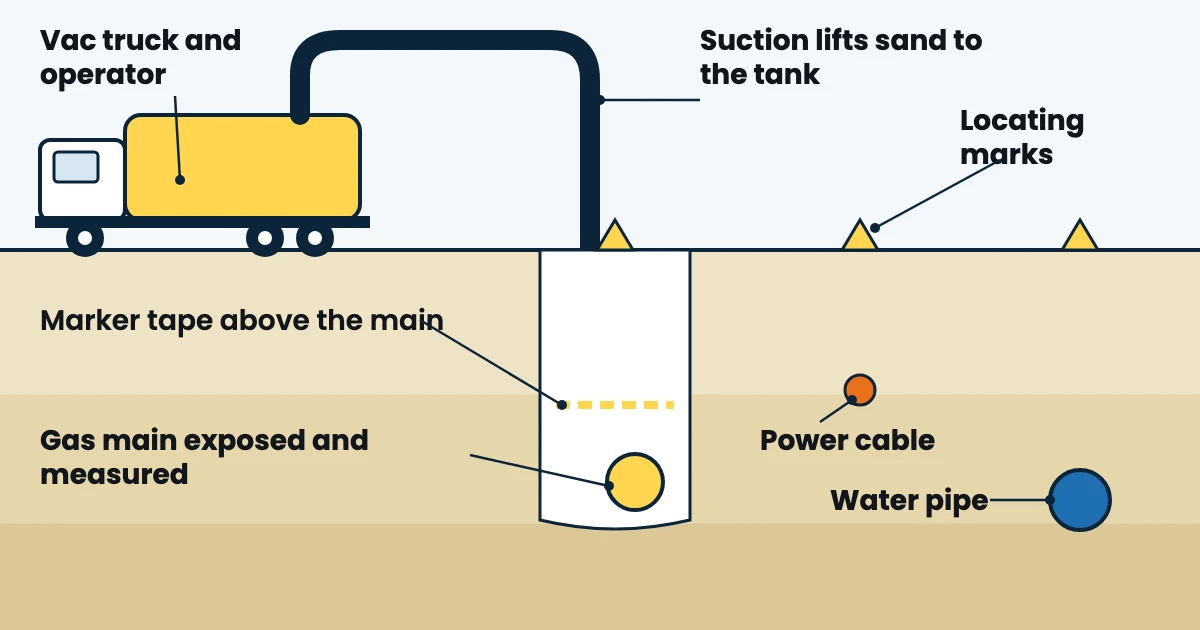
They are usually buried 300 mm to one metre deep, high-pressure plastic or steel mains have a marker tape 150 mm below the surface, and pressures range from one point two five kilopascals to one thousand nine hundred kilopascals.
For a gas leak or a damaged pipe, call Atco's faults and emergencies line on thirteen thirteen fifty-two.
Need the services on your plans proven before you dig?
Send us the plans, the dig area and your start date.
The truck arrives with an experienced operator and exposes each service so you can see it.
Call oh eight, five one two two, six oh nine nine, or get a free quote on our website.
Water Corporation pipes:
prescribed proximities.
Water Corporation needs approval for ground disturbing work inside set distances from its pipes.
These prescribed proximities come from section ninety of the Water Services Act twenty twelve, and its information sheet sets them out.
Ground disturbing work includes excavation, compaction, dewatering and heavy vehicle movement.
For sewer gravity pipelines and main drains, approval is needed within 2 m.
For water supply pipes under 300 mm in diameter, within four metres.
For water supply pipes of 300 mm and over, sewer pressure mains and drainage pressure mains, within six metres.
Water Corporation names vacuum excavation as a way to find its pipes.
Its locating our assets page describes potholing as careful hand digging of trial holes or other soft dig techniques, such as vacuum excavation, and says potholing is the only way of determining pipeline location with certainty.
Mechanical excavation is not allowed without a Clearance to Work Permit.
It also sets how much potholing to do.
Every crossing point is potholed where a new service crosses a pipeline.
For work running alongside a pipeline, pothole at five metre intervals, because alignments can vary.
Water Corporation asks for the location of potholed assets to be surveyed by a qualified surveyor, so it makes sense to have the surveyor record each exposed pipe while the hole is open.
To report damage to a Water Corporation asset, call thirteen thirteen seventy-five, twenty-four seven.
Telecoms, private lines and other services.
Electricity, gas, water and sewerage are not the only things under a Perth site.
The WorkSafe W A code also lists telephone and fibre optic cables, drainage pipes and soakwells, fuel lines and underground storage tanks.
It says some services have no metallic content and cannot be found with electromagnetic cable and pipe locators, and that ground penetrating radar can give their approximate location.
On private property, the code says as built drawings are often unreliable or lost, so exploratory hand digging will be needed to locate or confirm services.
That is the gap a locator and a vac truck fill together.
Our service locator and ground penetrating radar work helps find and mark services, including some that are not on the plans.
The vac truck then exposes each mark so it can be seen.
How a vac truck proves the plans on site.
The WorkSafe W A code says vacuum excavators are useful for locating or exposing underground utility services, and that they reduce the risk of contacting or cutting them.
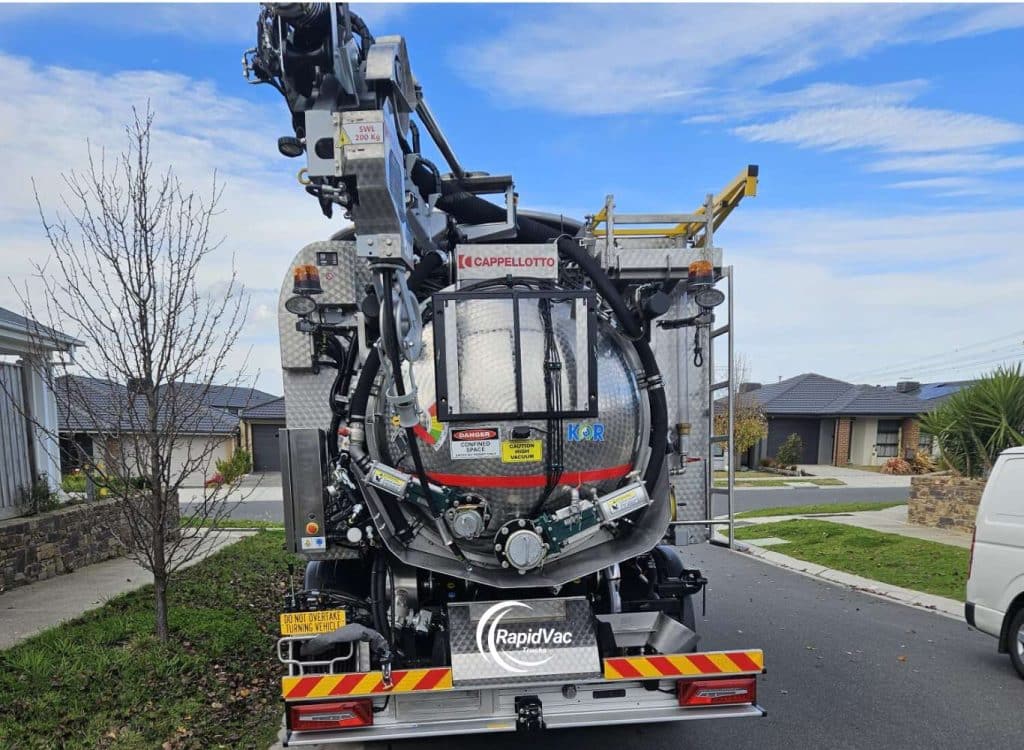
On a Rapid Vac Trucks Perth job, a water jet loosens the ground and the suction hose lifts it into the truck, so nothing hard is driven at the service.
This is how a proving dig usually runs.
First, read the plans and the marks together.
The operator checks your BYDA plans, any critical asset notification or Water Corporation conditions, and the locator's marks on the ground.
Second, set up around the site.
The truck parks where the hose reaches every dig point, with the work area protected as your plan requires.
Third, expose each service.
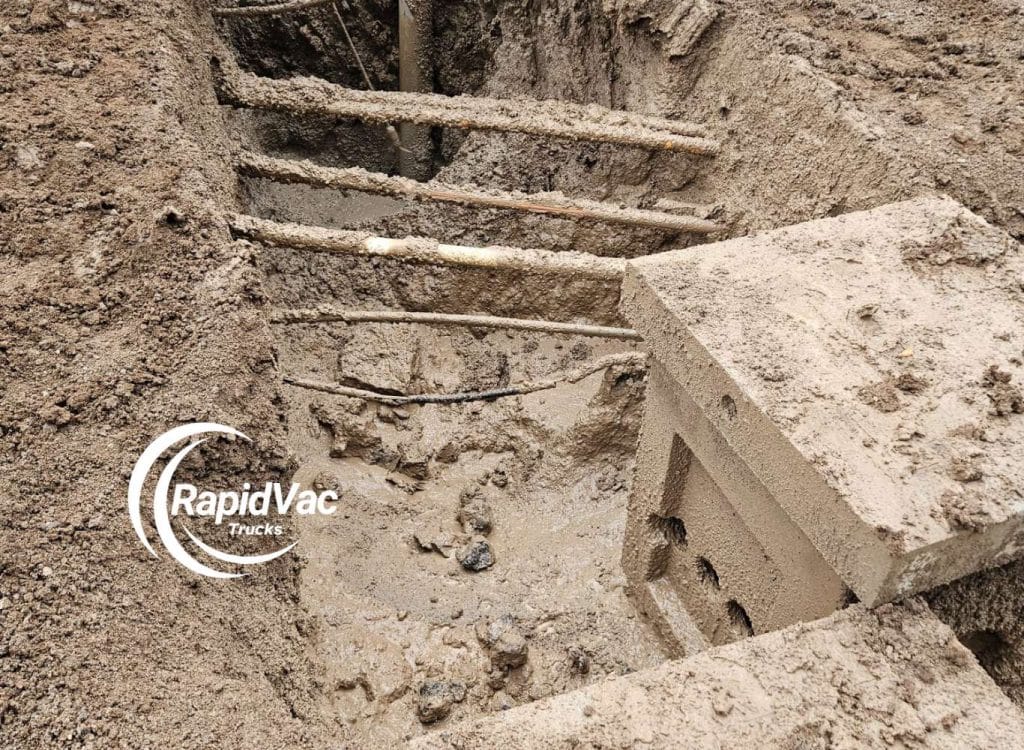
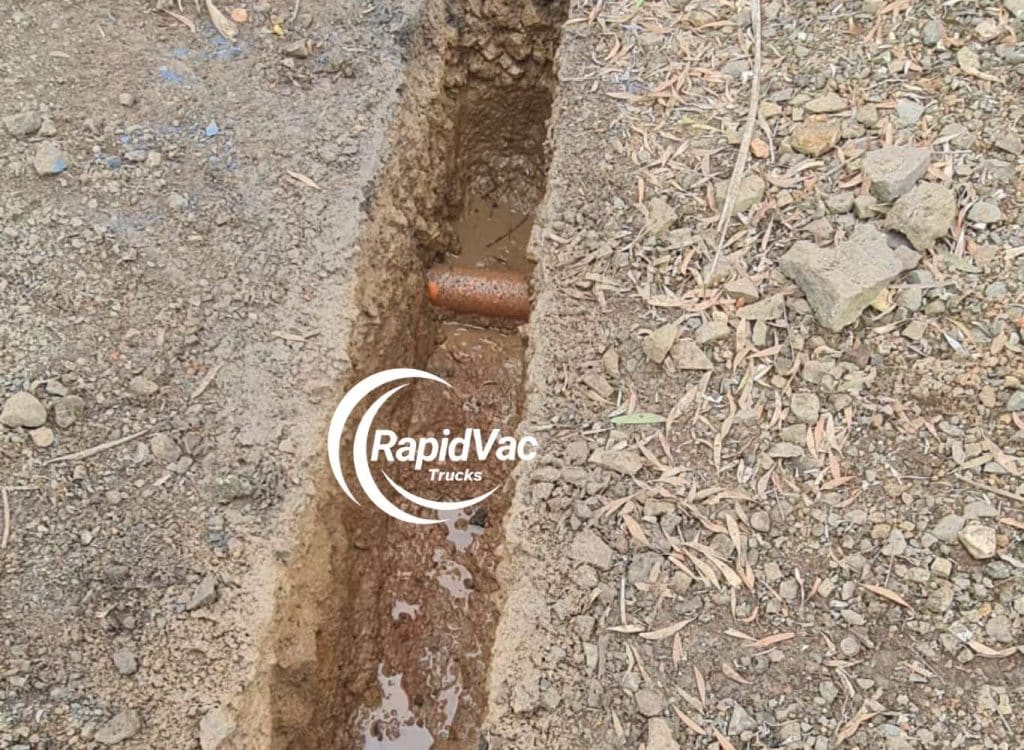
Small, neat holes at each mark, crossing point or interval, down to the top of the service, so it can be seen.
Fourth, measure what is found.
The depth from the surface and the position of each exposed service are measured on site, so your surveyor can record them.
Fifth, hand back a site you can dig from.
The holes are left open or backfilled as your conditions require.
Water Corporation, for example, asks for clean bedding material in the first 300 mm above an exposed pipe.
The main excavation then goes ahead around known services.
Sand needs care at the edge of any hole.
WorkSafe W A's code says hand trenching in sand should only be done to depths under one and a half metres unless the trench is shored or its sides are sloped back.
A proving dig with a vac truck is a small hole worked from the surface through the suction hose, and the spoil goes straight into the truck instead of being stockpiled at the edge.
How far ahead to plan a Perth dig.
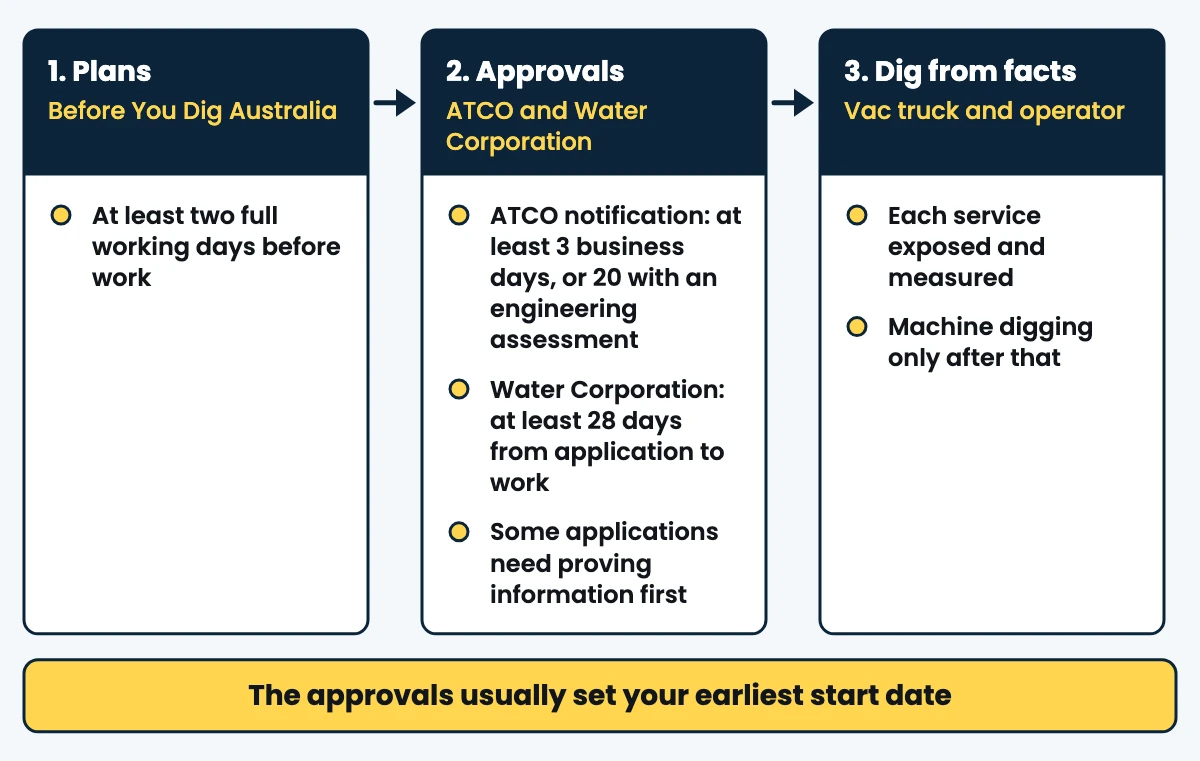
The asset owners' approvals, not the vac truck, usually set the earliest start date.
These are the lead times each owner states.
Before You Dig Australia:
lodge at least two full working days before work is due to start.
That is Atco's wording; Western Power says at least two days.
An Atco critical asset notification:
allow at least three business days, or twenty business days if an engineering assessment is needed.
Water Corporation approval:
allow at least twenty-eight days from application to the start of work.
It makes contact within five days and reviews within up to twenty-eight days, and conditions such as protection or relocation designs can take several months.
Western Power services near transmission and communication assets, such as clearance assessments or relocation:
request them at least 30 days before you need to start.
The approvals often need proving information, so a proving dig is often the first job on site, not the last.
Atco's application asks for the BYDA gas sequence number, the separation distance from the main, the machinery and method, and any proving information.
Booking the vac truck early gives you that evidence when you need it.
The WorkSafe W A code is also being replaced.
A draft code of practice for excavation work was open for public comment until the thirteenth of March, 2026, so check WorkSafe's page for the current version before you finalise your safe work method statement.
What to send when you book.
The more we know, the faster the job is planned.
When you call or use the quote form, include the site address and the exact dig area, with photos; your BYDA plans and job reference; any Atco critical asset notification or Water Corporation approval and its conditions; the services you need exposed, how many points, and how deep the main dig will go; access limits such as verges, kerbs, traffic, parking and hose distance; and your preferred start date and working hours.
Pricing is usually based on time on site, with the hourly rate and any minimum charge confirmed in your quote.
Hose extensions, access and the material removed all affect how long the job takes.
Our team works twenty-four seven, including on-site attendance for urgent and after-hours jobs, with timing confirmed when the work is scoped.
Ready to prove the services before you dig?
Call the Perth team on oh eight, five one two two, six oh nine nine, or send your plans and photos for a free quote.
Every truck comes with its operator.
Frequently asked questions.
Is Dial Before You Dig free in W A?
Yes.
Dial Before You Dig is now Before You Dig Australia, and Water Corporation's guidance still uses both names for the service at eleven hundred dot com dot A U.
Lodging an enquiry online or on eleven hundred is free.
Atco notes that a call cost may apply and some asset owners reserve the right to charge a modest fee for some plans.
How far ahead should I lodge a Before You Dig enquiry?
At least two full working days before work starts, according to Atco, and at least two days according to Western Power.
Allow longer if your work needs an Atco critical asset notification, at least three business days, or twenty with an engineering assessment, or Water Corporation approval, at least twenty-eight days from application to work.
Do Dial Before You Dig plans show depth and private pipes?
Not reliably.
Western Power says to use the plans as a guide only and never assume the depth and alignment of cables.
Private service lines and council street lights are usually not on its plans, and the WorkSafe W A code says the service cannot show privately owned facilities on private property.
Can a vac truck dig near a critical asset gas main?
The WorkSafe W A code says vacuum excavators reduce the risk of contacting or cutting services, but Atco's rules come first.
Works within fifteen metres of a critical asset main need Atco's evaluation and a critical asset notification, and mechanical digging within five metres is assessed by Atco.
We work to the conditions in your notification, alongside Atco's approved locator where it requires one.
What if we find a cable or pipe that is not on the plans?
Stop and call the asset owner.
Western Power asks you to call thirteen ten eighty-seven for an unlisted or damaged cable.
Call Atco on thirteen thirteen fifty-two for gas faults and emergencies, and Water Corporation on thirteen thirteen seventy-five to report damage to its assets.
Dial Before You Dig WA, the service named in WorkSafe WA's excavation code, now runs as Before You Dig Australia (BYDA), and it is still the first step before any dig in Perth. You lodge an enquiry online or call 1100, and each member asset owner sends plans of what it has recorded near your site. ATCO's Working Around Gas Infrastructure page describes BYDA as a free service.
The plans are where the job starts, not where it ends. Western Power's excavation safety page says to use BYDA plans as a guide only, never to assume the depth and alignment of cables, and that it is mandatory to physically locate all services before excavation. Water Corporation and WorkSafe WA say the same thing in their own words. Rapid Vac Trucks Perth does that physical locating with a vac truck and an experienced operator, across Perth, 24/7.
Key takeaways
- Dial Before You Dig in WA means a free Before You Dig Australia enquiry, online or on 1100, at least two full working days before you dig.
- The plans are a guide. Private lines and some council assets are not on them, and depth is never guaranteed.
- Western Power, ATCO and Water Corporation each set distances and approvals around their assets before machine digging.
- A vac truck exposes each service so you can see it, measure it and dig from facts.
What Dial Before You Dig gives you in WA
A BYDA enquiry gets you the recorded location of underground assets from the owners who are members. The WorkSafe WA code says all public utilities and most service providers are members, so a Perth enquiry can return Western Power cables, ATCO gas mains and Water Corporation water, sewer and drainage pipes, among others. Western Power says its own plans arrive within 15 minutes of a request being submitted.
What the plans leave out matters as much as what they show. WorkSafe WA's Excavation: Code of practice says the Dial Before You Dig service is a valuable source of information in road reserves and public areas, but the information "may not always be complete" and it cannot show privately owned facilities on private property. Western Power adds that private service lines, such as the cable from the green dome to the house, and council-owned street lights will not appear on its plans unless they are privately registered.
The WorkSafe WA code also says underground services should be assumed to be present until proven otherwise, and that trench excavations in street reserves will almost certainly meet them. On a Perth verge, plan to find services, not to miss them.
Western Power cables: the approach distances
Western Power sets minimum approach distances for powered tools and plant near its underground cables. The voltage on your plans decides which one applies.
| Cable voltage | Powered tools or plant must stay back | Hand tools or non-destructive digging |
|---|---|---|
| Up to 1,000 V (low voltage) | 30 cm | Approach with care, avoid contact |
| Over 1,000 V up to 33 kV (high voltage) | 50 cm | Approach with care, avoid contact |
| Over 33 kV up to 330 kV (transmission) | 3 m | Approach with care, avoid contact |
Western Power must assess any works within 3 m of cables of 33 kV and above, and permits or authorisations may be required.
Western Power's process is the five Ps: Plan, Prepare, Pothole, Protect and Proceed. You plan with a BYDA enquiry, a job risk assessment and a safe work method statement. You prepare by reviewing the plans, looking for clues on site such as streetlights, pillars and meters, and engaging a BYDA certified locator before potholing. You pothole by hand or other non-destructive means to prove the location and depth of each service. Western Power is clear that mechanical excavation only starts after all services have been identified and exposed.
If you cannot find a cable shown on the plans, find damaged insulation, or uncover a cable that is not on the plans, Western Power says to stop work and call it on 13 10 87.

ATCO gas mains: when you need a critical asset notification
ATCO's WA gas distribution network includes mains it classes as critical assets. On its Critical Asset Notifications page, ATCO says all works proposed within 15 metres of critical asset gas infrastructure must be evaluated by ATCO. Once ATCO consents, it issues a critical asset notification listing the permitted activities and conditions, and a copy must stay on site.
The list of works ATCO counts is wider than digging. It includes heavy vehicle crossings, equipment storage, compaction, piling, fencing, pole installation, boring, tree removal and stump grinding, footpaths and crossovers.
ATCO wants the main proven by sight. The page says the position and top level of gas pipelines should be proven using direct visual identification during planning. Only Quality A, a positive identification of the asset, is accepted for installation work. Quality B, an electronic location, has a stated tolerance of ±300 mm horizontally and up to ±500 mm vertically, which is why ATCO accepts it for design only. Not all of ATCO's plastic pipes carry a tracer wire, so some cannot be found with an electromagnetic locator at all. In that case, ATCO says one of its approved locators must carry out the Quality A proving.
Two more ATCO conditions shape a Perth job:
- Mechanical digging within 5 metres of a critical asset main must be assessed by a trained and competent ATCO employee or contractor.
- Where ATCO requires one of its approved locators, that locator attends at the applicant's cost, and the vac truck works alongside them to the notification's conditions.
The WorkSafe WA code gives the wider picture for any gas main: they are usually buried 300 mm to one metre deep, high-pressure plastic or steel mains have a marker tape 150 mm below the surface, and pressures range from 1.25 kPa to 1900 kPa. For a gas leak or a damaged pipe, call ATCO's faults and emergencies line on 13 13 52.
Need the services on your plans proven before you dig?
Send us the plans, the dig area and your start date. The truck arrives with an experienced operator and exposes each service so you can see it.
Water Corporation pipes: prescribed proximities
Water Corporation needs approval for ground disturbing work inside set distances from its pipes. These prescribed proximities come from section 90 of the Water Services Act 2012, and its information sheet sets them out. Ground disturbing work includes excavation, compaction, dewatering and heavy vehicle movement.
| Water Corporation asset | Approval needed for ground disturbing works within |
|---|---|
| Sewer gravity pipelines and main drains | 2 m |
| Water supply pipes under 300 mm diameter | 4 m |
| Water supply pipes 300 mm and over, sewer pressure mains and drainage pressure mains | 6 m |
Water Corporation names vacuum excavation as a way to find its pipes. Its Locating our assets page describes potholing as careful hand digging of trial holes or other soft dig techniques, such as vacuum excavation, and says potholing is the only way of determining pipeline location with certainty. Mechanical excavation is not allowed without a Clearance to Work Permit.
It also sets how much potholing to do. Every crossing point is potholed where a new service crosses a pipeline. For work running alongside a pipeline, pothole at 5 m intervals, because alignments can vary. Water Corporation asks for the location of potholed assets to be surveyed by a qualified surveyor, so it makes sense to have the surveyor record each exposed pipe while the hole is open. To report damage to a Water Corporation asset, call 13 13 75, 24/7.
Telecoms, private lines and other services
Electricity, gas, water and sewerage are not the only things under a Perth site. The WorkSafe WA code also lists telephone and fibre optic cables, drainage pipes and soakwells, fuel lines and underground storage tanks. It says some services have no metallic content and cannot be found with electromagnetic cable and pipe locators, and that ground penetrating radar can give their approximate location.
On private property, the code says "as built" drawings are often unreliable or lost, so exploratory hand digging will be needed to locate or confirm services. That is the gap a locator and a vac truck fill together. Our service locator and ground penetrating radar work helps find and mark services, including some that are not on the plans. The vac truck then exposes each mark so it can be seen.

How a vac truck proves the plans on site
The WorkSafe WA code says vacuum excavators are useful for locating or exposing underground utility services, and that they reduce the risk of contacting or cutting them. On a Rapid Vac Trucks Perth job, a water jet loosens the ground and the suction hose lifts it into the truck, so nothing hard is driven at the service.
This is how a proving dig usually runs:
- Read the plans and the marks together. The operator checks your BYDA plans, any critical asset notification or Water Corporation conditions, and the locator's marks on the ground.
- Set up around the site. The truck parks where the hose reaches every dig point, with the work area protected as your plan requires.
- Expose each service. Small, neat holes at each mark, crossing point or interval, down to the top of the service, so it can be seen.
- Measure what is found. The depth from the surface and the position of each exposed service are measured on site, so your surveyor can record them.
- Hand back a site you can dig from. The holes are left open or backfilled as your conditions require. Water Corporation, for example, asks for clean bedding material in the first 300 mm above an exposed pipe. The main excavation then goes ahead around known services.
Sand needs care at the edge of any hole. WorkSafe WA's code says hand trenching in sand should only be done to depths under 1.5 metres unless the trench is shored or its sides are sloped back. A proving dig with a vac truck is a small hole worked from the surface through the suction hose, and the spoil goes straight into the truck instead of being stockpiled at the edge. For larger jobs, see our vacuum excavation and non-destructive digging services, and how civil teams use them in 5 civil construction projects in Perth.

How far ahead to plan a Perth dig
The asset owners' approvals, not the vac truck, usually set the earliest start date. These are the lead times each owner states:
- Before You Dig Australia: lodge at least two full working days before work is due to start (ATCO; Western Power says at least two days).
- ATCO critical asset notification: allow at least 3 business days, or 20 business days if an engineering assessment is needed.
- Water Corporation approval: allow at least 28 days from application to the start of work. It makes contact within 5 days and reviews within up to 28 days, and conditions such as protection or relocation designs can take several months.
- Western Power services near transmission and communication assets, such as clearance assessments or relocation: request them at least 30 days before you need to start.
The approvals often need proving information, so a proving dig is often the first job on site, not the last. ATCO's application asks for the BYDA gas sequence number, the separation distance from the main, the machinery and method, and any proving information. Booking the vac truck early gives you that evidence when you need it.
The WorkSafe WA code is also being replaced. A draft code of practice for excavation work was open for public comment until 13 March 2026, so check WorkSafe's page for the current version before you finalise your safe work method statement.
What to send when you book
The more we know, the faster the job is planned. When you call or use the quote form, include:
- the site address and the exact dig area, with photos;
- your BYDA plans and job reference;
- any ATCO critical asset notification or Water Corporation approval and its conditions;
- the services you need exposed, how many points, and how deep the main dig will go;
- access limits such as verges, kerbs, traffic, parking and hose distance;
- your preferred start date and working hours.
Pricing is usually based on time on site, with the hourly rate and any minimum charge confirmed in your quote. Hose extensions, access and the material removed all affect how long the job takes. Our team works 24/7, including on-site attendance for urgent and after-hours jobs, with timing confirmed when the work is scoped. You can also see what Perth customers say on our Google profile.
Ready to prove the services before you dig?
Call the Perth team or send your plans and photos for a free quote. Every truck comes with its operator.
Frequently asked questions
Is Dial Before You Dig free in WA?
Yes. Dial Before You Dig is now Before You Dig Australia (Water Corporation's guidance still uses both names for the service at 1100.com.au), and lodging an enquiry online or on 1100 is free. ATCO notes that a call cost may apply and some asset owners reserve the right to charge a modest fee for some plans.
How far ahead should I lodge a Before You Dig enquiry?
At least two full working days before work starts, according to ATCO, and at least two days according to Western Power. Allow longer if your work needs an ATCO critical asset notification (at least 3 business days, or 20 with an engineering assessment) or Water Corporation approval (at least 28 days from application to work).
Do Dial Before You Dig plans show depth and private pipes?
Not reliably. Western Power says to use the plans as a guide only and never assume the depth and alignment of cables. Private service lines and council street lights are usually not on its plans, and the WorkSafe WA code says the service cannot show privately owned facilities on private property.
Can a vac truck dig near a critical asset gas main?
The WorkSafe WA code says vacuum excavators reduce the risk of contacting or cutting services, but ATCO's rules come first. Works within 15 m of a critical asset main need ATCO's evaluation and a critical asset notification, and mechanical digging within 5 m is assessed by ATCO. We work to the conditions in your notification, alongside ATCO's approved locator where it requires one.
What if we find a cable or pipe that is not on the plans?
Stop and call the asset owner. Western Power asks you to call 13 10 87 for an unlisted or damaged cable. Call ATCO on 13 13 52 for gas faults and emergencies, and Water Corporation on 13 13 75 to report damage to its assets.
This guide is general information based on public guidance from WorkSafe WA, Western Power, ATCO and Water Corporation as at 13 November 2026. Always follow the plans, notifications and conditions issued for your site.